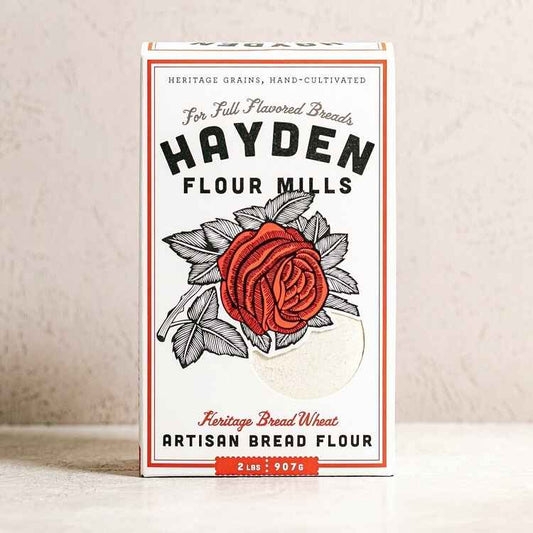

What You'll Need
90 g 100% hydration sourdough starter
360 g water, room temperature
10 g fine salt
450 g Better Bread Flour
Directions
-
Refresh your starter with Better Bread Flour 8 to 12 hours before you mix the dough (See Notes for Baker below). Stir until no lumps remain, cover loosely with a lid, and let it ferment for 8 to 12 hours. The starter should at least double in size when it is ready, and it will smell fragrant and yogurt-like.
-
To mix the dough, stir the water and salt together in a large bowl. Add the starter and break it up with your fingers or whisk until the water appears milky. Add the flour to the bowl and mix the dough with your hand or using a dough whisk, squeezing the dough until no lumps remain. Clean down the sides of the bowl with a bowl scraper and pull the dough toward the middle. It will appear shaggy and pasty at this stage.
-
Cover with a dry tea towel or a bowl cover and bulk ferment for about 4 hours at a warm room temperature (about 75 to 80°F). During this time, perform stretch-and-folds every 30 to 45 minutes to develop dough strength: with a wet hand, release one side of the dough from the bowl, gently stretch it about three to four inches, and fold it over toward the center. Rotate the bowl and repeat, working your way around the dough mass until you return to the first fold. The dough will progress from a shaggy mass to a smooth, bouncy dough as it ferments and is repeatedly folded with rests in between.
-
To pre-shape, dust your work surface with flour and set an 8 to 9-inch proofing basket lined with a tea towel to the side. Use your bowl scraper to transfer the dough to the floured surface, being mindful not to pull or tear at the dough. Using floured hands, arrange the dough into a rectangle running vertically to your body. Perform a letter fold: fold the top third toward the middle, then fold the bottom third up to overlap. If the seam wants to pop open, pinch it to keep it in place. Rotate the dough 180 degrees. Perform a triangle fold: fold the top 2 to 3 inches toward the middle, then overlap with the two sides to form a triangle tip. Perform a tuck & roll: roll from the top down the length of the dough until the seam is on the bottom. Pinch the ends and tuck them under and set aside to relax, about 15 minutes.
-
To final shape, use your bench knife to turn the dough over. Perform a triangle fold: fold the top 2 to 3 inches toward the middle, then overlap with the two sides to form a triangle tip. Next, perform a tuck & roll: roll from the top down the length of the dough until the seam is on the bottom, this time tucking more intentionally with your thumbs to gain tension as you roll the loaf. Dust the top of the loaf well with flour, and using your bench knife, tuck it into the seam to seal and release the loaf from the work surface. Turn it over in your hands and cradle it into the basket seam side facing up. Pinch the seam closed if necessary.
-
Cover with a bowl cover or drape with a dry tea towel before placing it in a reusable plastic bag. Refrigerate for at least 8 hours, or up to 24 hours, to develop flavor. The longer the cold proof, the more pronounced the sourdough flavor.
-
The next day, remove the loaf from the refrigerator and proof it at a warm room temperature until it is puffy and gases are visibly trapped under the surface of the dough. This can take anywhere from 1 to 3 hours, depending on the health of your starter and the temperature of your refrigerator and the room.
-
About 30 minutes before the loaf is ready to bake, preheat a Dutch oven or a baking steel with a baking dome placed on the middle rack to 500°F. Cut a piece of parchment paper so it is about 3 to 4 inches longer and wider than the proofing basket, or use a silicone bread baking mat instead. Turn the loaf out onto the parchment or mat. Dust lightly with flour, if desired, rubbing it gently into the top of the loaf to create a more even layer of flour.
-
Using a bread lame, score the loaf about 1/4 to 1/2 inch deep along its length. This score can be made halfway or three-quarters of the way across the loaf. This is where the loaf will open and bloom in the oven as steam and gases escape. To create a decorative pattern, cut shallow marks into the loaf, if desired.
-
Using heavy-duty oven mitts or oven pads, remove the Dutch oven and set it on the stove top. Remove the lid and use the parchment paper rim or the mat handles to carefully lower the loaf into the Dutch oven. Position the lid and transfer the Dutch oven back into the oven. Bake for 20 minutes. Lower the oven temperature to 475°F and continue baking for another 20 minutes. (If you have a gas oven with the flame on the bottom, or your loaves tend to burn on the bottom before they are done, you may need to adjust this schedule: after removing the lid and lowering the oven temperature, continue baking for about 7 minutes to set the crust. Once the crust is set, carefully remove the loaf from the Dutch oven by the parchment paper or mat and continue baking on the middle rack for another 10 to 15 minutes, or until your desired crust color.)
-
When the loaf is done, it will be a deep, golden brown and will sound hollow when thumped on the bottom. Remove the loaf from the Dutch oven and set it to cool on a wire rack for at least 2 hours before slicing. Store in a fabric bread bag at room temperature for up to 3 days or in a beeswax-coated fabric for up to 5 days, toasting as desired. Alternatively, slice and store in a freezer bag for up to 1 month, removing individual slices to toast when desired.
Notes for Baker
Starter tip: We recommend making your starter using Better Bread Flour: In a small bowl, combine 10 g of refreshed mother starter with 40 g water and 40 g Better Bread Flour. Stir until no lumps remain, cover with a lid or a plate, and let it ferment for 8 to 12 hours before mixing the dough. It should at least double in size when it is ready, and it will smell fragrant and yogurt-like.
Open crumb tip: Once you get a feel for the process and are confident in your scoring and shaping skills, try adding about 15 g to 20 g more water to the dough during mixing. This helps to open the crumb of the bread, if that is something you desire.
Makes 1 loaf
Recipe contributed by Sarah Owens.