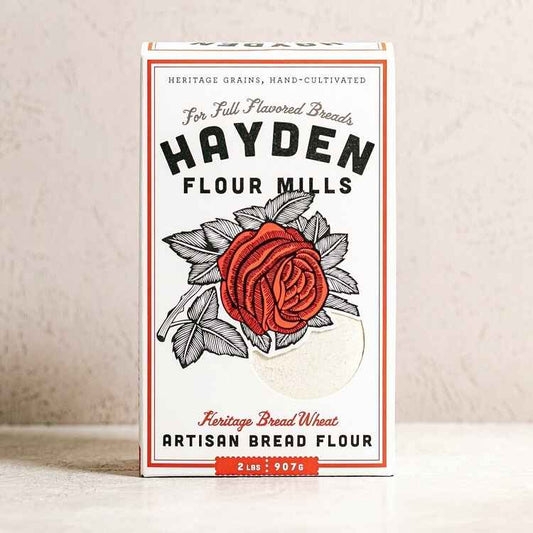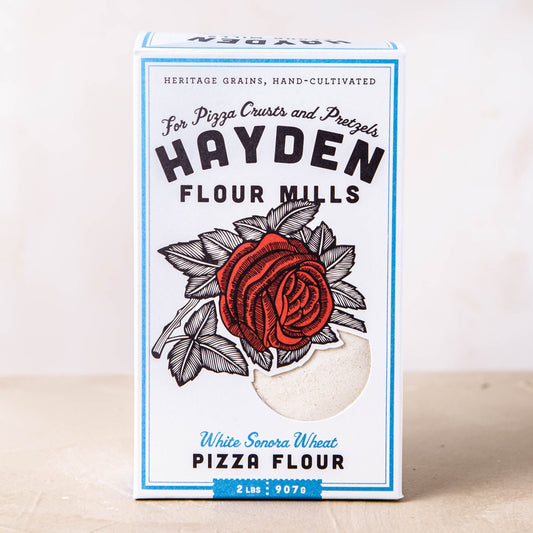

What You'll Need
Spelt Starter
10 grams sourdough starter (100% hydration)
35 grams water
35 grams Spelt Flour
Dough
80 grams Spelt Starter (see above)
383 grams water
35 grams maple syrup
10 grams fine salt
30 grams melted butter or neutral oil
450 grams Spelt Flour
Tools
mixing bowl
wire cooling rack
9 x 5 x 2 3/4 inch pan
Dutch oven or a baking steel + baking dome that fits over your pan
(NOTE: Spelt has a more fragile gluten structure than standard wheat, so steam is especially important when baking a spelt loaf. It keeps the surface supple long enough for the loaf to rise upward before the crust sets.)
Directions
-
Make the starter. Stir the starter, water, and flour together in a small bowl until the flour is fully hydrated and evenly combined. Cover with a lid or plate and ferment at room temperature for 8 to 12 hours, or until the starter doubles in size.
-
Mix the dough. Combine the starter, water, maple syrup, and salt in a large bowl. Drizzle in the melted butter and mix with your hand or a spoon to break up the starter and dissolve the salt. Add the flour and mix with your hand, squeezing until no dry lumps remain. The dough should feel spongy and soft. Cover with a dry towel or reusable plastic bag and set aside.
-
Build strength. Perform a stretch-and-fold every 45 minutes, about four times total over about 3 1/2 hours. With a wet hand, release the dough from the bowl, gently stretch it four to five inches, and fold it over to the center. Rotate the bowl and repeat, working your way around the dough until you return to the first fold. After about 3 1/2 hours, the dough should feel marshmallow-like and have increased in volume by at least one-third.
-
Shape. Grease a 9 x 5 x 2 3/4 inch baking pan with nonstick baking spray or butter and set aside. Shape the loaf using the stitch-and-roll method to build a strong, tall rise. Stretch the dough into a vertical rectangle. Then stitch it: pull small sections from the left and right sides toward the center, overlapping them like shoelaces to build tension down the length of the dough. Next, starting at the top of your stitched loaf, roll the dough toward you tightly, like a yoga mat, using your thumbs to tuck the surface under itself with each rotation. You'll feel a taut skin form around the outside of the loaf. Pinch the seam shut and place the loaf seam-side down, tucking the sides in with floured fingers so the loaf rests evenly in the pan to help the loaf rise up rather than out. Cover with a tea towel, then a reusable plastic bag.
-
Choose your final ferment. Because this loaf is wholegrain, it will not hold for a long period of time. At this point, you can choose to cold ferment or room ferment to bake the same day.
-
Cold ferment (overnight): Place the covered loaf in the refrigerator for a maximum of 8 to 10 hours. When you're ready to bake, remove the pan from the refrigerator and let the loaf warm up to room temperature (about 75 to 80 degrees F) for 1 to 2 hours, until pillowy and the gases feel trapped under the surface of the dough.
-
Room ferment (same day): Cover the loaf and final proof at room temperature for about 2 to 2 1/2 hours, or until the dough has crested the rim of the pan. It's ready to bake when pillowy and the gases feel trapped under the surface of the dough.
-
Preheat oven. Place a Dutch oven, or a baking steel + baking dome that will fit the pan, on the middle rack of your oven. Preheat oven to 475°F.
-
Stencil (optional). This loaf does not need to be scored if properly proofed. To apply a stencil, lay it over the top of the loaf. Using a sieve or shaker, dust the stencil with bread flour and then gently rub the flour into the stencil. Carefully remove the stencil.
-
Bake. Transfer the loaf to the Dutch oven or baking steel. Position the lid or dome over the top and bake for 20 minutes. Then, remove the lid and lower the oven temperature to 450°F. If using a baking steel, remove it now. After 40 total minutes, remove the loaf from the pan and squeeze the sides. If the sides feel squishy, continue baking the loaf out of the pan, placing directly onto the middle rack, until the sides are crusty and firm (about 5 minutes).
-
Cool and store. Transfer the loaf to a wire cooling rack and cool completely (about 2 hours) before slicing. Store in a plastic bag at room temperature for up to 3 days, or in a beeswax-coated linen for up to 5 days, toasting as necessary. Alternatively, slice and store in a freezer bag for up to 1 month, removing individual slices to toast when desired.
Makes 1 loaf
Recipe contributed by Sarah Owens.